
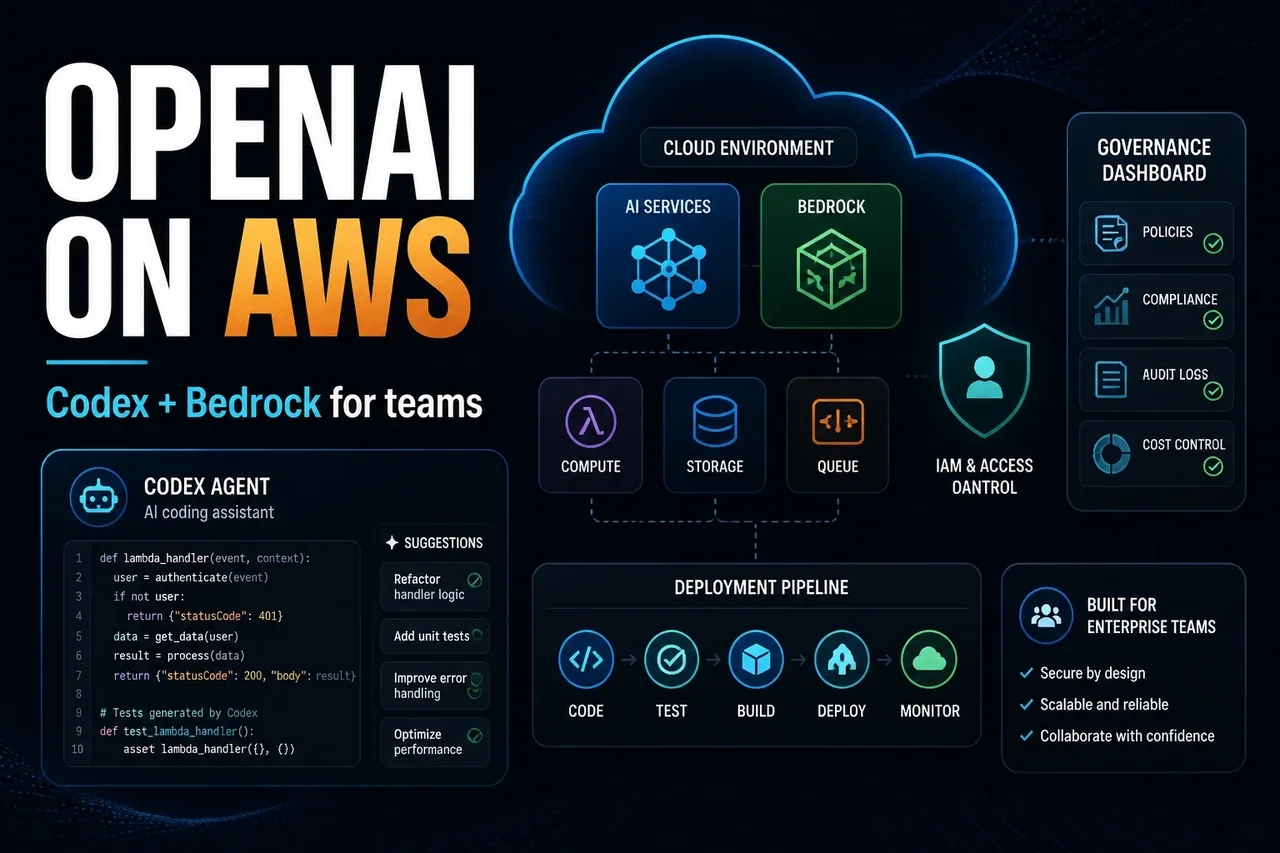
OpenAI on AWS and Codex on Bedrock: What It Means for Enterprise AI Teams
OpenAI on AWS and Codex on Bedrock: What It Means for Enterprise AI Teams
1. Introduction: Why OpenAI on AWS Matters
OpenAI frontier models becoming available through AWS is a major enterprise AI milestone because it reduces one of the biggest blockers for large organizations: operational adoption. Many companies already run their infrastructure, security controls, identity, networking, observability, data platforms, and procurement through AWS. When OpenAI models become available through AWS and Amazon Bedrock, AI teams can evaluate frontier models without creating a completely separate operating model.
OpenAI’s announcement says OpenAI frontier models and Codex are now available on AWS, giving enterprises a way to bring OpenAI capabilities into existing security, compliance, procurement, billing, and governance workflows. The announcement specifically highlights two paths: OpenAI models on Amazon Bedrock and Codex on Amazon Bedrock.
For CTOs, AI leads, platform teams, and cloud architects, the important question is not simply “Can we call another model?” The real question is: Can we safely operationalize AI at enterprise scale using the controls our organization already trusts?
This article explains what was announced, why Bedrock matters for procurement and governance, how Codex on Bedrock changes software engineering workflows, and when teams should use OpenAI directly versus OpenAI through AWS.
2. What Was Announced
OpenAI announced that its frontier models and Codex are available on AWS. According to OpenAI, enterprises can access these capabilities in two main ways: OpenAI models on Amazon Bedrock for AI application development using AWS-native controls, and Codex on Amazon Bedrock for software engineering workflows such as writing, reviewing, debugging, and modernizing code.
The announcement also says these offerings are intended to help AWS customers move from AI evaluation to production with less friction, especially around procurement, security review, and production readiness.
There is one practical nuance enterprise teams should note: OpenAI’s announcement frames this as generally available on AWS, while AWS and OpenAI availability pages may label OpenAI on Amazon Bedrock as “Limited preview.” AWS also states that GPT-5.5 and GPT-5.4 are available in preview on Amazon Bedrock.
Practical interpretation: treat this as an important availability milestone, but verify your AWS account, region, model access, commercial terms, and feature maturity before building a production roadmap around it.
3. Why Amazon Bedrock Changes Enterprise AI Procurement
Amazon Bedrock matters because procurement is often the hidden blocker in enterprise AI. A prototype can be built in days, but production approval may take months if legal, security, cloud governance, finance, and compliance teams need to approve a new vendor path.
By offering OpenAI capabilities through AWS, enterprises may be able to route model usage through existing AWS procurement, billing, identity, access management, network architecture, and cloud governance processes. OpenAI explicitly positions the AWS path as a way to reduce friction around procurement, security review, and production readiness.
For decision makers, this changes the conversation from:
- “Can our developers use OpenAI?”
- “Can finance approve a new vendor?”
- “Can security review a separate platform?”
- “Can we centralize usage, billing, and access?”
to:
- “Can we expose approved OpenAI models through our existing AWS platform?”
- “Can we use AWS identity and governance patterns?”
- “Can platform teams provide a managed AI service layer to internal teams?”
This does not automatically solve compliance. Bedrock availability is not the same as being compliant with every internal policy or industry regulation. Enterprises still need their own governance, access controls, data classification, prompt logging policy, evaluation process, audit controls, and human review workflows.
4. Codex on Bedrock: Implications for Software Engineering Teams
Codex on Bedrock is especially important for enterprise software teams because coding agents touch sensitive assets: source code, architecture decisions, internal APIs, credentials, infrastructure scripts, tests, and deployment pipelines.
OpenAI’s Codex Bedrock documentation says that when Codex is configured with Amazon Bedrock as the model provider, the OpenAI-hosted Responses API is not in the request path. Instead, Codex sends model requests to Amazon Bedrock, and Bedrock provides an OpenAI-compatible Responses API implementation for supported OpenAI models. Authentication is AWS-native through a Bedrock API key or AWS IAM credentials.
That is a big architectural difference for enterprises. It means platform teams can align Codex usage with AWS account boundaries, IAM roles, SSO, region strategy, and internal access review processes.
Practical use cases for Codex on Bedrock include:
- Legacy code modernization: generate migration plans, refactor modules, create tests, and explain old code.
- Secure code review: identify risky patterns, missing validation, and dependency issues before merge.
- Developer onboarding: help engineers understand large repositories, internal services, and build steps.
- Test generation: generate unit, integration, and regression tests for existing services.
- Infrastructure-as-code assistance: review Terraform, CloudFormation, Kubernetes YAML, and CI/CD pipeline files.
However, Codex on Bedrock is not feature-identical to every OpenAI-hosted Codex workflow. OpenAI’s docs note that some features depending on OpenAI-hosted cloud services, hosted tools, or cloud-managed discovery are not currently available. Fast Mode is also not available with the initial Bedrock offering, which supports on-demand inference only.
5. Architecture Patterns for Enterprise AI on AWS
Enterprise teams should not let every application call foundation models directly. A better pattern is to create a governed AI platform layer that handles authentication, routing, logging, evaluation, cost controls, and policy enforcement.
Pattern 1: Central AI Gateway
Create an internal AI gateway that exposes approved model endpoints to application teams. The gateway can route requests to OpenAI models through Bedrock, apply rate limits, redact sensitive data, log metadata, and enforce model selection rules.
Pattern 2: RAG Application on AWS
For internal copilots and knowledge assistants, use a retrieval-augmented generation architecture. Documents are ingested into a search or vector index, the application retrieves relevant context, and the model generates an answer with citations. This reduces hallucination risk and gives governance teams a clearer data path.
Pattern 3: Agentic Workflow with Tool Controls
For workflows like ticket triage, code review, report generation, or support automation, the model should not directly access every tool. Instead, expose specific approved tools with scoped permissions. Every tool call should be logged, validated, and reversible where possible.
Pattern 4: Codex for Local Developer Workflows
Codex can be configured to use Amazon Bedrock as the model provider. OpenAI’s docs show support for local Codex workflows including CLI, IDE extension, SDK, scriptable workflows, local code review, sandboxing, permission controls, worktrees, and built-in Git tools.
Sample Reference Architecture
A practical enterprise architecture could look like this:
- User signs in through corporate SSO.
- Application sends the request to an internal AI gateway.
- Gateway checks IAM role, project, data classification, and allowed model policy.
- For RAG, the app retrieves approved context from Amazon OpenSearch, a vector database, or an internal knowledge index.
- The gateway invokes OpenAI models through Amazon Bedrock.
- Responses are filtered, evaluated, logged, and returned to the application.
- Telemetry flows into CloudWatch, SIEM, cost dashboards, and MLOps evaluation reports.
This architecture gives product teams flexibility while giving platform and security teams centralized control.
6. OpenAI API Directly vs OpenAI Through AWS/Bedrock
| Decision factor | Use OpenAI API directly | Use OpenAI through AWS/Bedrock |
|---|---|---|
| Fastest access to latest OpenAI-native features | Usually better | May lag or have limited feature parity |
| AWS-first enterprise governance | Requires separate integration | Usually better fit |
| Procurement through existing AWS contracts | May require new vendor process | Stronger fit |
| IAM, SSO, and AWS account controls | Needs custom design | Stronger fit |
| Multi-cloud or cloud-neutral product | Often simpler | Can increase AWS dependency |
| Codex local workflows with AWS auth | OpenAI-hosted path | Good fit when Bedrock features meet requirements |
| Feature maturity and availability | Check OpenAI docs | Check AWS region, preview status, and supported models |
| Cost management | Managed via OpenAI billing and usage controls | Can align with AWS cost allocation and cloud budgets |
Decision rule: choose direct OpenAI when you need the broadest OpenAI-native feature set and fastest access. Choose AWS/Bedrock when enterprise procurement, AWS governance, IAM alignment, and platform centralization are more important than immediate feature parity.
7. Governance, IAM, Logging, Compliance, and Data Controls
OpenAI on AWS can make enterprise governance easier to implement, but it does not replace governance. Teams should design a formal AI control plane.
Governance Controls to Implement
- Model allowlist: define which OpenAI models are approved for which workloads.
- IAM-based access: map teams, roles, and workloads to approved model actions.
- Data classification: block restricted data from prompts unless approved.
- Prompt and response logging: log safely, with redaction and retention policies.
- Evaluation gates: require quality, safety, latency, and cost tests before production.
- Human review: require approval for code changes, external communications, financial actions, and regulated decisions.
- Incident response: define what happens when an AI output leaks sensitive data or causes a business issue.
OpenAI’s Codex Bedrock documentation states that Codex can authenticate through a Bedrock API key or the AWS SDK credential chain, including shared AWS config, environment variables, AWS SSO, named profiles, and federated identity via credential_process.
That gives platform teams a familiar identity model, but the enterprise still owns permission design. Poor IAM design can still expose models too broadly, allow unapproved data usage, or make cost attribution difficult.
8. Cost and Procurement Considerations
Moving OpenAI usage into AWS can simplify procurement for AWS-first organizations, but teams still need to model cost carefully. AI costs are not only token costs. They include retries, retrieval, embeddings, vector storage, document parsing, logging, evaluation runs, monitoring, human review, and engineering maintenance.
Platform teams should calculate:
- Cost per request
- Cost per successful workflow
- Cost per user per month
- Cost per repository or service for Codex workflows
- Cost of evaluation and regression testing
- Cost difference between direct OpenAI and Bedrock routes
For procurement, the main benefit is not always lower price. The benefit may be faster approval, centralized vendor management, AWS budget alignment, cost tagging, and easier internal chargeback. CTOs should compare total operational cost, not only model pricing.
9. Use Cases: Code Modernization, Internal Copilots, RAG Apps, Support Automation
Code Modernization
Codex on Bedrock can help teams analyze old services, generate refactoring plans, write migration tests, and assist with framework upgrades. Keep humans in the loop for architecture decisions and production merges.
Internal Copilots
Build internal copilots for HR, finance, engineering, legal, sales, or operations. Use RAG so answers are grounded in approved enterprise documents instead of relying only on model memory.
RAG Applications
RAG apps are a strong fit for Bedrock because they combine enterprise data with model reasoning. Use cases include policy assistants, technical support search, product documentation copilots, and executive research tools.
Support Automation
Support teams can use AI to classify tickets, suggest responses, summarize customer history, and route issues. Avoid fully autonomous customer responses until you have strong evaluation, escalation, and approval workflows.
Security and Engineering Review
OpenAI’s announcement also mentions future availability for Daybreak, including cyber models and Codex Security for secure code review, threat modeling, patch validation, dependency risk analysis, detection, and remediation guidance. Treat this as a capability to watch and evaluate when available for your environment.
10. Risks and Limitations
- Feature parity risk: Bedrock-backed OpenAI usage may not support every OpenAI-native feature immediately. OpenAI’s Codex docs explicitly list several unavailable or limited features for the Bedrock configuration.
- Regional availability risk: supported models and features may vary by AWS Region. OpenAI’s Codex docs advise confirming the selected model is available in the configured AWS Region.
- Preview/maturity risk: AWS’s OpenAI on Bedrock page labels the offering as limited preview, so teams should validate maturity before production adoption.
- Governance risk: AWS-native access does not automatically mean safe usage. Bad prompts, poor IAM, weak logging, and missing evaluations can still create business risk.
- Vendor lock-in risk: building too tightly around Bedrock-specific APIs, AWS-only IAM assumptions, or provider-specific model behavior can make future migration harder.
- Cost risk: agentic workflows can silently multiply calls through retries, tool use, long context, and evaluation loops.
11. Migration Checklist for Teams Already Using OpenAI Directly
| Step | Action | Owner |
|---|---|---|
| 1 | Inventory all current OpenAI API use cases, models, prompts, tools, and data flows. | AI platform team |
| 2 | Classify workloads by sensitivity: public, internal, confidential, regulated, code-related. | Security + data governance |
| 3 | Check Bedrock availability for required models, regions, quotas, and features. | Cloud architecture |
| 4 | Compare direct OpenAI features with Bedrock-supported features. | Engineering lead |
| 5 | Create an abstraction layer so apps do not hard-code one provider path. | Platform engineering |
| 6 | Run side-by-side evaluations for quality, latency, safety, and cost. | MLOps |
| 7 | Design IAM roles, logging, redaction, cost tagging, and approval workflows. | Cloud + security |
| 8 | Migrate low-risk workloads first, such as summarization, internal search, or test generation. | App teams |
| 9 | Review production incidents, hallucination rates, human corrections, and cost variance. | AI governance board |
| 10 | Decide whether to standardize, run hybrid, or keep direct OpenAI for selected workloads. | CTO + AI leadership |
Concise Codex on Bedrock Configuration Example
The following is an illustrative local configuration based on OpenAI’s Codex Bedrock setup guidance. Teams should confirm region, model access, and internal credential policy before use.
# ~/.codex/config.toml
model_provider = "amazon-bedrock"

# Shell environment using AWS SSO / named profile
export AWS_REGION=us-east-2
aws sso login --profile codex-bedrock
export AWS_PROFILE=codex-bedrock

# Verify provider inside Codex CLI
codex /status
12. Final Recommendation
OpenAI on AWS is most valuable for enterprises that already treat AWS as their primary cloud control plane. If your organization depends on AWS IAM, procurement, billing, cloud governance, logging, and platform engineering standards, Bedrock can make OpenAI adoption easier to approve and operate.
However, this should not be treated as an automatic migration decision. Direct OpenAI access may still be better for teams that need the newest OpenAI-native features, broader Codex cloud capabilities, or provider-neutral architecture. Bedrock may be better for organizations that prioritize AWS governance, centralized procurement, and controlled rollout.
The best enterprise strategy is often hybrid: use direct OpenAI where feature velocity matters, use OpenAI on Bedrock where AWS governance and procurement matter, and build an internal AI platform layer so applications can switch providers without major rewrites.
Bottom line: OpenAI on AWS does not remove the need for governance. It gives enterprise teams a more familiar place to implement it.
FAQ
1. Does OpenAI on AWS mean enterprises no longer need separate AI governance?
No. AWS access can help align with existing cloud controls, but enterprises still need their own policies for data handling, IAM, logging, evaluation, cost control, and human approval.
2. Should we migrate from direct OpenAI API to Bedrock immediately?
Not automatically. Start with a workload inventory, feature comparison, region check, cost model, and side-by-side evaluation. Migrate low-risk workloads first.
3. What is the biggest benefit of Codex on Bedrock?
The biggest benefit is running Codex local workflows with AWS-native authentication and access controls, which can be easier for enterprise platform and security teams to govern.
4. Are all Codex features available on Bedrock?
No. OpenAI’s Codex Bedrock documentation notes that some OpenAI-hosted cloud features are not currently available, and Fast Mode is not available in the initial Bedrock offering.
5. What should CTOs ask before approving OpenAI on Bedrock?
Ask whether required models are available in your AWS Region, whether your IAM model is ready, how prompts and responses will be logged, how costs will be allocated, and how model quality will be evaluated before production.
This part helped me understand why Codex on Bedrock is different. If Responses API is implemented by Bedrock, our security review can be much simpler.
That’s the key distinction. The request path and auth model often matter more to enterprise reviewers than the model name itself.
In my setup, IAM roles map cleanly to teams, but model selection rules are messy. Some workloads need latest features, others need stable Bedrock availability.
Does this also apply when the app already has a custom AI gateway? Seems like Bedrock mostly changes procurement and IAM, not the gateway architechture itself.
Does this also apply when using multi-cloud deployment? Moving OpenAI calls through AWS helps governance, but it also makes the AI layer less cloud neutral.
I tried this pattern with a central gateway and rate limits were the first practicle issue. Teams kept asking for direct model access to debug latency.
Small question: for RAG, would you still log prompts if they include retrieved internal docs? Our compliance team is nervous about prompt logging policy.
I’d log metadata by default, and only log full prompts after data classification rules are clear. Redaction and retention limits should be agreed first.
One small caveat: Codex without Fast Mode might be fine for review jobs, but for interactive IDE use the performence gap could change adoption a lot.
One thing I noticed is the preview wording matters a lot. We got burned before assuming Bedrock model access meant same region coverage and quota behavior.
Yes, exactly. I’d treat region, quotas, and preview status as explicit release criteria before committing any production dependency.