
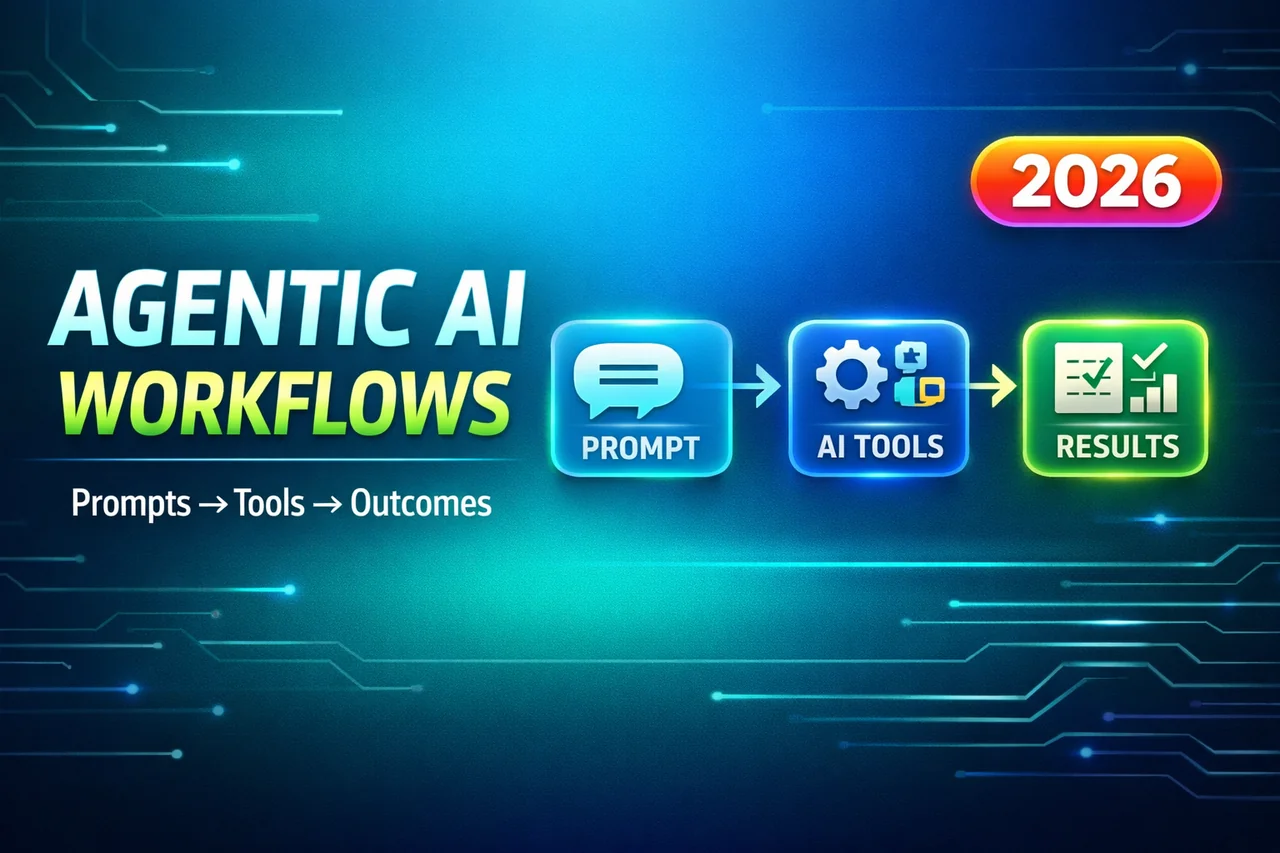
Agentic AI in 2026: From Single Prompts To End To End Workflows
Agentic AI in 2026: From Single Prompts To End To End Workflows
In January 2026, AI is no longer just a clever text generator. It is quietly running support queues, closing sales loops, monitoring infrastructure, and even checking out your online shopping cart.
The shift is from “answer this prompt” to “own this outcome” – and that shift is powered by agentic AI.
If your company is still stuck at “ask the bot a question and hope for the best”, this guide will show you what the leaders are already doing instead: handing outcomes to AI agents and letting them drive end to end workflows with guardrails.
Why Agentic AI Has Become The Big Story Of 2026
The hype cycle has moved. In 2023 the stars were chatbots and copilots. In 2024 it was “AI features everywhere”. In late 2025 and 2026, the spotlight is on agents that can:
- Understand a business goal, not just a single question
- Break that goal into steps and create a plan
- Call tools, APIs, and SaaS products to execute the plan
- Adapt when reality changes and ask for help only when needed
Analyst and vendor reports are converging on the same message: AI agents are moving from labs into real production. Market forecasts now expect tens of billions of dollars in dedicated agentic AI spend by 2030, with a large share of enterprise apps embedding task specific agents by the end of 2026. The message for leaders is simple:
agents are not a side project anymore, they are a new way of running work.
What Is Agentic AI, In Plain Language?
Lots of definitions float around, but the simplest way to think about it is this:
Agentic AI is AI that can reason, plan, and act on your behalf to achieve a goal, not just respond to single prompts.
Instead of:
- “Write a reply to this email.”
- “Summarize this PDF.”
you start saying things like:
- “Resolve this support ticket within policy and update every system that needs to know.”
- “Qualify this lead, book the next step, and keep the CRM accurate.”
- “Monitor this application and remediate standard incidents automatically.”
An AI agent:
- Has a goal and knows when it is done
- Has tools it can use to take actions, not just generate words
- Can maintain state over time instead of “forgetting” every step
- Can operate with rules and limits, so it does not roam free
The Agentic AI Ladder: From Prompts To Outcomes
Most teams do not jump straight from chatbots to fully autonomous workflows. They climb a ladder.
Level 0: Ad hoc prompting
People copy paste content into a chatbot, ask for drafts or summaries, then manually move outputs into other tools.
Value is real, but it is personal productivity, not process transformation.
Level 1: Embedded copilots
AI shows up inside tools you already use: your CRM suggests next email lines, your IDE explains code, your helpdesk auto drafts replies.
The copilot makes individual tasks faster, but each task still starts and ends with a person.
Level 2: Task focused agents
Now you assign a recurring job to an agent:
- “Triage all new support tickets and route them correctly.”
- “Summarize yesterday’s customer conversations and push insights to Slack.”
- “Reconcile invoices and flag mismatches for finance.”
The agent runs on a schedule or is triggered by events. It reads data, takes narrow actions, and hands off anything uncertain.
Level 3: End to end workflow agents
This is where the real magic happens. The agent owns a complete workflow, not just a slice:
- Support: from “ticket created” to “ticket fully resolved and reported”.
- Sales: from “lead captured” to “meeting booked and CRM updated”.
- Operations: from “alert detected” to “issue mitigated and postmortem drafted”.
Multiple tools, multiple systems, one agentic brain orchestrating the whole thing.
Level 4: Outcome as Agentic Solution (OaAS)
At the top level, you do not buy software or even “AI features” anymore. You buy outcomes delivered by agents.
In the OaAS model, a vendor says:
“Give us access to these systems. Our agents will keep your knowledge base current, resolve X percent of tickets within Y hours, and you pay based on the outcome.”
You contract for resolved tickets, secured endpoints, updated records – not just licenses. Vendors carry more execution risk, but they also have more control through agentic automation. This model is already being named explicitly in analyst webinars and SaaS strategy blogs, and it is expected to go mainstream through 2026 and beyond.
What Changed In Late 2025 And Early 2026
Three big shifts over the last year have made agentic workflows feel inevitable instead of experimental.
1. Agents are inside consumer experiences now
When a user can shop, compare options, and check out inside an AI chat instead of bouncing around websites, that is not a toy chatbot anymore, it is an agent that owns a journey.
Recent launches like Microsoft’s Copilot Checkout, built with partners such as PayPal, Shopify, and Stripe, are exactly that: agentic flows that take a vague intent like “find a good sofa under 800 dollars” all the way to “order placed, payment confirmed” without leaving the assistant interface.
2. Enterprise reports flipped from “what if” to “how soon”
Major cloud and integration vendors have spent the last months publishing detailed Agent Trends 2026 reports. They all repeat the same themes:
- Multi agent systems coordinating across business functions
- Hybrid architectures that mix LLM reasoning with APIs, events, and knowledge graphs
- Governance stacks for monitoring, approval, and audit of agents
- New roles inside companies: AI ops, agent engineers, and AI product owners
The tone has shifted from “someday” to “you need an agentic strategy this year if you want to keep up”.
3. Tooling caught up
In 2023 many “agents” were nothing more than brittle prompt chains held together with scripts. Today we have:
- Agent frameworks that manage long running flows, retries, and handoffs between agents
- Standard ways for exposing tools and APIs to agents without bypassing security
- Built in telemetry around which actions agents took and why
- Vendor platforms that ship agents with monitoring and kill switches out of the box
That does not remove all the hard problems, but it makes it much easier to go from idea to production.
Concrete Examples Of End To End Agentic Workflows
To make this real, here are four agent powered workflows that forward looking teams are deploying in 2025 and 2026.
1. Support: “From ticket opened to case closed”
Imagine a customer emails about a damaged product. A modern agent:
- Reads the email and retrieves the full order history and previous tickets
- Checks warranty and refund policy
- Classifies the issue and determines allowed resolution bands
- Looks up stock data to see if replacement is available
- Drafts a response with either refund options or replacement details
- Applies the action in the order system and updates the ticket
- Escalates to a human only if the case violates rules or looks risky
This is not a single prompt. It is a closed loop workflow touching email, CRM, order management, inventory, and analytics.
2. Revenue: “Lead captured to meeting booked”
For many B2B teams, agents now manage the messy middle between marketing and sales:
- Enrich new leads with firmographic and intent data
- Score and prioritize based on fit and readiness
- Draft personalized outreach for review or direct send
- Negotiate times and book meetings directly on calendars
- Summarize the call transcript back into CRM with next steps
Reps spend more time in real conversations, and less time wrestling with admin work. Leaders finally get cleaner pipeline data because the agent keeps hygiene under control automatically.
3. IT operations: “Alert triggered to issue mitigated”
In IT and security, agents change the game from watching dashboards to letting the system act in real time:
- Cluster related alerts into a single incident so humans are not flooded
- Query logs and metrics to form a hypothesis about root cause
- Run read only diagnostics to confirm or refute that hypothesis
- Execute safe remediation steps, like restarting a service or rolling back a config
- Open or update tickets with a natural language timeline of what happened
- Ping the on call engineer only when human judgment is really needed
4. Commerce: “Discovery to checkout inside chat”
With agentic checkout flows, commerce journeys look very different:
- Customer: “I need a black office chair under 300 dollars that fits in a small room.”
- Agent: searches across participating retailers, filters by size, price, and reviews
- Agent: shows two or three strong options with specs and tradeoffs
- Customer: chooses one and confirms shipping details
- Agent: completes payment through a trusted wallet partner and issues order confirmation
The user never touches a traditional category page, filter panel, or cart view. The agent owns the entire flow.
How Agentic Workflows Are Built Under The Hood
Behind every smooth agentic experience is a stack of very practical components. Understanding them helps you design systems that are powerful and safe.
1. A reasoning engine
Large language models still do the “thinking”. They:
- Interpret ambiguous human requests
- Break goals into steps
- Decide which tool to call next
- Explain what they did in natural language
2. A tools and integration layer
Tools are how agents stop being talkers and become doers. Common categories:
- Business tools: CRM, ERP, HR, billing, ticketing, analytics
- Communication: email, chat, SMS, voice, notification systems
- Internal APIs: pricing engines, scoring models, inventory, risk checks
- Search and retrieval: knowledge bases, document stores, data lakes
In 2026, more vendors are exposing “agent ready” APIs with built in permission models, rate limits, and logging so platform teams can give agents controlled access without hacks.
3. Orchestrators and multi agent coordination
Real workflows rarely fit inside a single loop. Orchestrators:
- Track tasks over time, including retries and branches
- Route work between specialized agents (for example, one for policy, one for pricing)
- Persist state so that long running work survives restarts
- Emit events and logs for monitoring
4. Memory and context
Powerful agents remember:
- Conversation history around the current task
- Previous attempts and their outcomes
- Customer or system preferences relevant to decisions
This memory can live in vector stores, databases, or knowledge graphs, but the key is the same: agents must be able to recall what happened and learn from it.
5. Guardrails and governance
As soon as agents touch money, people, or infrastructure, guardrails are not optional:
- Permissions that define which agent can see and do what
- Policies that encode hard rules (for example, refund limits, approval thresholds)
- Human in the loop checkpoints for high risk actions
- Audit logs that record every decision and tool call
The most successful deployments in 2025 and 2026 design this governance layer first, then allow more autonomy as confidence grows.
A Playbook To Move From Prompts To End To End Workflows
Ready to move beyond chat experiments? Here is a practical playbook you can follow over the next ninety days.
Step 1: Pick one high value, low risk workflow
Look for a process that is:
- Repetitive and text or data heavy
- Well documented or at least documentable
- Easy to define success for (“ticket closed within X hours”, “invoice matched”)
- Safe to constrain with policy (for example, small refunds, internal requests)
Step 2: Map the journey from trigger to outcome
For that workflow, write down:
- What event starts it
- Every system involved
- Every human decision involved
- What “done” looks like for each case
This becomes your blueprint for an agent that owns the flow instead of a human glueing steps together.
Step 3: Wrap actions in safe APIs and tools
Before the agent arrives, create the “levers” it will pull:
- Read only APIs for data access
- Action APIs for specific allowed operations
- Built in checks so the API itself enforces limits, not the prompt
Think of it like child proofing your systems. The agent can only reach what you decide.
Step 4: Build a narrow agent with explicit boundaries
For your first agent, make the scope boringly clear:
- Inputs it will accept
- Outcomes it is responsible for
- Things it will never do (for example, touching high value accounts)
- Situations where it must escalate to a person
Step 5: Instrument everything and start in shadow mode
Run the agent alongside your existing workflow for a while:
- Let it propose actions without executing them
- Have humans compare its decisions with what they would have done
- Measure accuracy, coverage, and time saved
Once you trust it, flip specific actions to “auto approve” while keeping high risk steps under human review.
Step 6: Expand horizontally, not just deeper
After a successful first deployment:
- Clone the pattern into adjacent workflows
- Reuse the governance stack you already set up
- Introduce specialized agents that talk to each other instead of one giant super agent
This creates an agentic mesh across your business rather than a fragile AI monolith.
Risks To Watch And How To Keep Agents On Your Side
Powerful agents can create powerful problems if they are rushed into production. The most common failure modes seen in early deployments include:
- “Workslop”: low quality or hallucinated outputs that humans have to clean up
- Silent failures: agents quietly do the wrong thing and nobody notices until customers complain
- Shadow agents: teams spin up their own agents without platform or security oversight
- Compliance gaps: no clear record of why an agent took a certain action
You can avoid most of these by:
- Defining clear success metrics before you deploy
- Logging every tool call and decision with context
- Reviewing samples of agent activity on a schedule
- Giving someone explicit ownership of “agent ops” and quality
- Involving legal, risk, and data teams early instead of after a problem
What To Do This Week If You Want To Be Ready For The Agentic Era
You do not need to boil the ocean to start benefiting from agentic AI in 2026. Here is a simple five day sprint you can run with a cross functional team:
- Day 1: List your top ten text or data heavy workflows. Vote on which two are most painful and most automatable.
- Day 2: For the top workflow, map the start, the end, and every system in between on a whiteboard.
- Day 3: Mark which steps require true human judgment and which are rule based. The rule based steps are your first candidates for an agent.
- Day 4: Identify the APIs or tools a future agent would need. Start a backlog of “agent ready” APIs you must expose safely.
- Day 5: Write a one page charter for your first agent: scope, guardrails, owners, and success metrics.
By the end of that week you will not have a full agentic platform, but you will have something just as important: a shared mental model of what agentic AI means for your company and a concrete first project that can graduate from prompts to outcomes.