
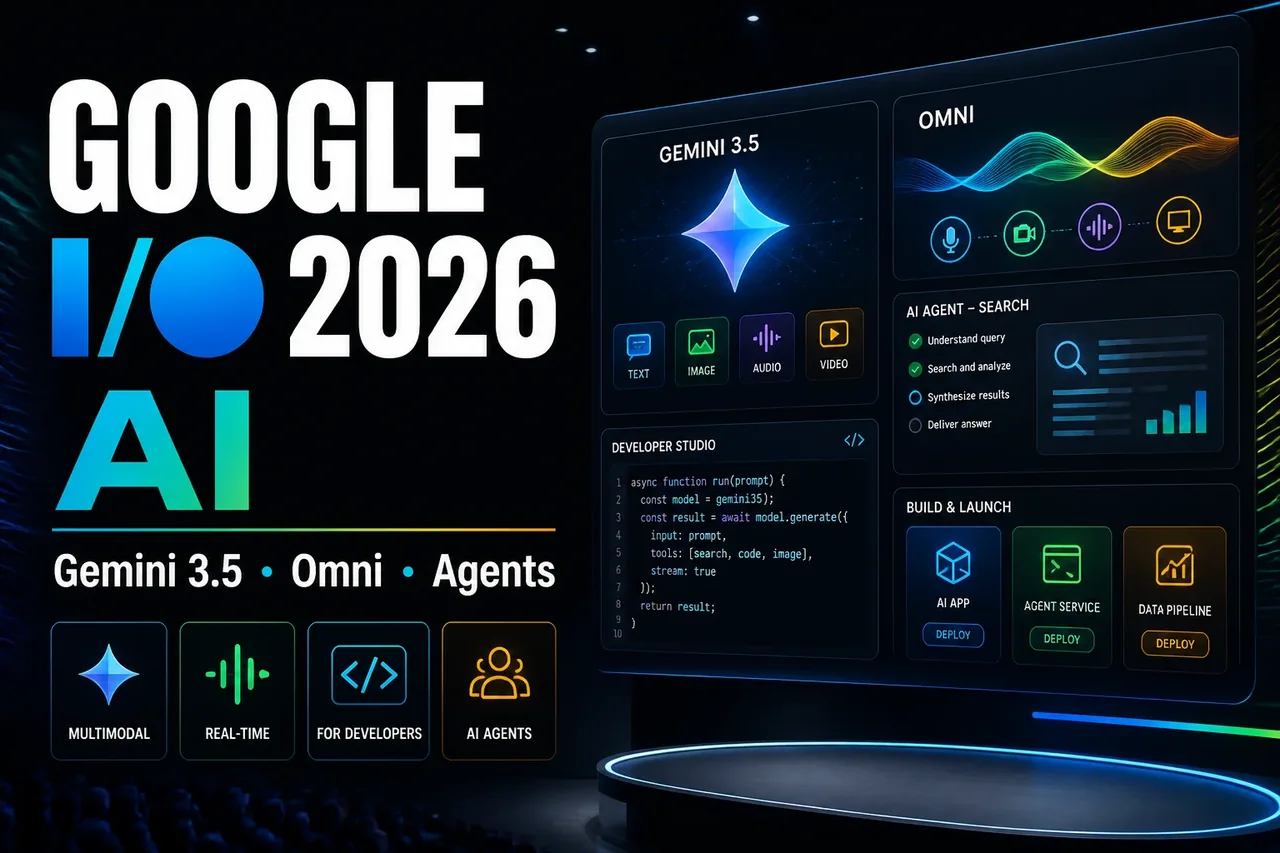
Google I/O 2026 AI Announcements Explained for Developers
Google I/O 2026 AI Announcements Explained for Developers
1. Introduction: Why Google I/O 2026 Matters for AI Developers
Google I/O 2026 is important because Google is no longer presenting AI as only a chat interface. The main direction is clear: faster models, multimodal creation, agent-first development tools, AI-powered Search, product-level assistants, and deeper integration across Android, YouTube, Workspace, Shopping, and smart devices.
For developers, the biggest shift is from “prompt a model and show a response” to “build systems where AI can reason, call tools, execute tasks, generate interfaces, browse information, and operate inside real product workflows.” Google’s own I/O collection says the company released Gemini Omni and Gemini 3.5, expanded Google Antigravity, and introduced agentic experiences such as Search information agents, Gemini Spark, Daily Brief, and Universal Cart.
This article explains what matters from a builder’s point of view: what you can use now, what is still early, and how to evaluate these announcements before adding them to real products.
2. Quick Summary of the Major AI Announcements
| Announcement | What it means | Developer relevance |
|---|---|---|
| Gemini 3.5 Flash | A fast frontier model designed for coding, agentic tasks, and long-horizon workflows. | Use for coding agents, tool-calling, document workflows, automation, and low-latency AI features. |
| Gemini Omni | A multimodal generation model that starts with video and combines text, image, video, and audio references. | Useful for creative tools, video editing apps, learning content, marketing automation, and media workflows. |
| Google Antigravity | An agent-first development platform with desktop, CLI, SDK, subagents, hooks, and asynchronous task management. | Important for teams building AI coding workflows and custom internal agents. |
| Managed Agents in Gemini API | A single API call can provision an isolated Linux environment where an agent can reason, use tools, execute code, and manage files. | Useful for automation apps, research agents, data agents, code execution flows, and tool-using AI products. |
| Gemini Spark | A 24/7 personal AI agent built on Gemini 3.5 and Antigravity. | Signals where consumer AI assistants are going, but it is still early and limited in rollout. |
| AI in Search, Shopping, YouTube, Android XR | Google is putting AI agents and multimodal experiences inside mainstream user surfaces. | Developers should expect discovery, commerce, content, and device UX patterns to change. |
3. Gemini 3.5 Flash: What It Is and Where It Fits
Gemini 3.5 Flash is the most immediately relevant announcement for developers. Google describes it as the first model in the Gemini 3.5 family, built for “frontier intelligence with action.” It is available through Google Antigravity, the Gemini API in Google AI Studio, Android Studio, Gemini Enterprise Agent Platform, Gemini Enterprise, the Gemini app, and AI Mode in Search.
The practical interpretation is simple: Gemini 3.5 Flash is Google’s main workhorse model for agentic coding, tool use, and high-speed multimodal reasoning. Google says it outperforms Gemini 3.1 Pro on several coding and agentic benchmarks, including Terminal-Bench 2.1, GDPval-AA, MCP Atlas, and CharXiv Reasoning, while targeting Flash-style speed.
Where it fits:
- Use it when you need fast AI responses with strong reasoning.
- Use it for coding agents, repository migration, UI generation, data extraction, and document understanding.
- Use it when latency and cost matter more than using the absolute largest model.
- Evaluate it carefully before replacing a tuned production workflow, especially if your app depends on deterministic outputs.
For real products, Gemini 3.5 Flash should be tested like an execution engine, not just a chatbot model. Measure task success rate, tool-call correctness, latency, cost per completed workflow, retry rate, and human review effort.
4. Gemini Omni: Multimodal Input/Output and World Understanding
Gemini Omni is Google’s new multimodal creation model. Google says it can “create anything from any input,” starting with video. It can combine text, images, audio, and video as inputs and generate high-quality videos grounded in Gemini’s real-world knowledge.
This matters because many AI media tools still feel like isolated generators: text-to-image here, video editor there, voice model somewhere else. Omni points toward a single multimodal editing loop: upload references, describe changes, refine over multiple turns, preserve character consistency, and use natural language as the editing interface.
For developers, the best early use cases are not “make a random video.” Better use cases are structured workflows:
- Generate ecommerce product videos from product images and feature text.
- Create educational explainers from diagrams or technical notes.
- Build marketing variants from a brand kit and sample campaign assets.
- Turn user-generated clips into platform-safe remix content.
- Create training simulations where physics and context matter.
Google says Omni includes improved understanding of physics such as gravity, kinetic energy, and fluid dynamics, and all Omni-created videos include SynthID watermarking. That is useful for trust and transparency, but teams should still add their own content policy checks, rights checks, moderation, and human approval for commercial media.
Adoption note: Gemini Omni Flash is rolling out through the Gemini app, Google Flow, and YouTube Shorts/Create. Google also said developer and enterprise APIs would follow in the coming weeks, so production teams should verify current API access and limits before committing roadmap work.
5. Google Antigravity: Agent-First Development Workflows
Google Antigravity is one of the most developer-important parts of I/O 2026. It is Google’s agent-first development platform, and Google expanded it with Antigravity 2.0 desktop, Antigravity CLI, Antigravity SDK, Google Cloud integrations, and Managed Agents in the Gemini API.
The key idea is that coding assistants are evolving from autocomplete tools into managed agent systems. Antigravity is designed around agent conversations, artifacts, multi-agent orchestration, subagents, hooks, and asynchronous task management. Google says Gemini 3.5 Flash has been co-optimized with the Antigravity harness.
Practical developer workflows enabled by Antigravity include:
- One agent migrates a codebase while another writes tests.
- One agent generates brand assets while another builds a landing page.
- A CLI agent runs repository maintenance tasks from the terminal.
- An SDK-based agent is hosted on your own infrastructure with custom behavior.
- A managed API agent executes code in an isolated Linux environment.
The safest way to adopt this is to start with non-production tasks: documentation updates, test generation, static analysis, migration planning, data cleanup, prototype generation, and internal dashboards. Move toward production code changes only after you have review gates, automated tests, permissions, rollback plans, and audit logs.
6. Gemini Spark and Product-Level Agents
Gemini Spark is Google’s 24/7 personal AI agent. Google says Spark runs on Gemini 3.5, uses the Antigravity harness, integrates with Workspace tools, and can keep working in the background even when a laptop is closed or a phone is locked.
From a product-builder perspective, Spark is less about one standalone feature and more about a product pattern: persistent agents that remember goals, watch for triggers, use connected apps, and ask for approval before sensitive actions. Google gives examples such as flagging hidden subscription fees, extracting school deadlines from inbox updates, and synthesizing meeting notes into a Google Doc and draft email.
However, Spark is still early. Google says it is rolling out to trusted testers first, with a planned beta for U.S. Google AI Ultra subscribers. Builders should watch Spark closely, but should not assume the same capabilities are available as a stable developer platform for every product today.
7. AI in Search, Shopping, YouTube, Android, and Smart Devices
Google is also moving AI into user-facing surfaces. Search gets Gemini 3.5 Flash as the default model in AI Mode, a redesigned AI-powered search box, multimodal search inputs, information agents, generative UI, and mini-app-like dashboards.
Shopping gets Universal Cart, a Gemini-powered intelligent cart that can work across Search, Gemini, YouTube, and Gmail, monitor price drops, check stock, reason about product compatibility, and use Google Wallet context for payment perks.
YouTube gets Ask YouTube for conversational video discovery and Gemini Omni-based remixing in Shorts and YouTube Create. Google says Ask YouTube can compile relevant long-form videos and Shorts into a structured response, while Omni remixing includes digital watermarks and links back to original videos.
Android XR and smart devices also matter. Google announced intelligent eyewear with audio glasses and display glasses, with first audio glasses planned in partnership with Gentle Monster, Warby Parker, and Samsung. For developers, this means more AI-first interfaces will be voice, camera, context, and wearable driven.
8. What Developers Can Build With These Tools
- AI codebase migration assistant: Use Gemini 3.5 Flash and Antigravity to analyze old code, propose migration steps, generate tests, and open reviewable pull requests.
- RAG research agent: Combine Gemini 3.5 Flash with retrieval, citations, tool calls, and evaluation to produce grounded research reports.
- AI ecommerce content studio: Use Gemini Omni for product videos, Gemini 3.5 Flash for copy, and human approval for publish-ready assets.
- Customer onboarding agent: Extract information from long documents, ask clarifying questions, validate fields, and route cases to humans.
- Learning app with multimodal explainers: Convert lecture notes, diagrams, and slides into interactive visuals and short video explanations.
- Internal operations copilot: Monitor inboxes, tickets, sheets, logs, and dashboards, then summarize issues and propose next actions.
9. Comparison: Gemini 3.5 Flash vs Gemini Omni vs Existing Gemini Models
| Model / family | Best use | Strength | Current developer interpretation |
|---|---|---|---|
| Gemini 3.5 Flash | Agents, coding, tool use, fast reasoning, multimodal understanding | High capability with Flash-style speed | Most practical I/O 2026 model for developers to test immediately. |
| Gemini Omni | Video generation, multimodal editing, creative workflows | Any-input-to-video direction, conversational editing, world understanding | Powerful for media apps, but API availability and production controls need verification. |
| Gemini 3 / 3.1 models | Existing production Gemini apps, multimodal apps, general AI features | Established model family and baseline for comparison | Keep using where stable; benchmark 3.5 Flash before migration. |
| Gemini Pro-class models | Deep reasoning, complex analysis, premium workflows | Higher ceiling for complex reasoning | Use when quality matters more than latency or cost. |
| Flash-Lite / smaller models | High-volume classification, extraction, routing, simple summarization | Cost efficiency and scale | Use for cheap background tasks before escalating to stronger models. |
10. Practical Architecture Ideas for Apps Using Google’s 2026 AI Stack
Architecture 1: Agentic Coding Workflow
- Frontend: internal dashboard for tasks and approvals.
- Agent layer: Antigravity or Managed Agents.
- Model: Gemini 3.5 Flash for planning, coding, and tool calls.
- Tools: Git, CI, test runner, issue tracker, documentation system.
- Safety: branch isolation, test gates, human approval, rollback.
Architecture 2: RAG + Agent Workflow
- Ingestion: documents, webpages, PDFs, logs, and support tickets.
- Index: vector search plus keyword search.
- Reasoning: Gemini 3.5 Flash for answer synthesis and action planning.
- Execution: tools for CRM, email, calendar, database, or ticketing.
- Evaluation: citation coverage, answer accuracy, tool-call success, hallucination rate.
Architecture 3: Multimodal Content Pipeline
- Input: product images, brand guidelines, user video, scripts.
- Planning: Gemini 3.5 Flash generates storyboard and asset plan.
- Generation: Gemini Omni creates or edits video.
- Review: moderation, brand QA, legal approval, watermark verification.
- Publishing: YouTube, ecommerce PDP, ads, or social media scheduler.
11. Risks: Cost, Reliability, Privacy, Vendor Lock-In, and Evaluation
Cost: Agentic systems can run many model calls, tool calls, retries, file operations, and background jobs. Price the full workflow, not just one prompt.
Reliability: Agents fail differently from chatbots. They may choose the wrong tool, stop early, loop, misread a document, or complete the wrong subtask. Build test suites around workflows.
Privacy: Spark-like experiences depend on connected apps and personal context. Treat Gmail, Calendar, Drive, payment, and browsing permissions as high-risk scopes. Use least privilege, explicit consent, logs, and deletion controls.
Vendor lock-in: Antigravity, Gemini API, Google Workspace, Android, Search, and YouTube integrations are powerful, but they can tie your product to Google’s stack. Keep your business logic separate from model/provider-specific code.
Evaluation: Do not evaluate only answer quality. Track task completion, human correction rate, factuality, latency, token cost, tool-call accuracy, user trust, and safety incidents.
12. Developer Takeaway Table
| Builder type | What to pay attention to | Recommended next step |
|---|---|---|
| AI/ML engineer | Evaluation, orchestration, model routing, tool use | Create benchmark tasks comparing Gemini 3.5 Flash with your current models. |
| App developer | AI Studio, Android support, Gemini API, Antigravity export | Prototype one user-facing AI feature and one internal automation. |
| Product founder | New product categories around agents, video, search, and commerce | Validate workflows where AI saves time, not just adds novelty. |
| Student | Agentic AI, multimodal AI, RAG, MLOps | Build a portfolio project using retrieval, tool calls, and evaluation. |
What to Use Now vs Watch Later
| Use now | Why | Watch later | Why |
|---|---|---|---|
| Gemini 3.5 Flash | Generally available through developer surfaces announced by Google. | Gemini 3.5 Pro | Google said it was being used internally and expected later. |
| Google AI Studio Android app building | Useful for rapid prototypes and test-track publishing workflows. | Production-grade vibe-coded apps | Still require normal engineering, QA, security, and Play review. |
| Antigravity desktop / CLI / SDK | Useful for internal developer productivity and agent experiments. | Fully autonomous production code agents | Need strong review, testing, and permission controls. |
| Managed Agents | Useful for controlled tool execution and sandboxed workflows. | High-risk autonomous workflows | Payments, emails, legal, finance, and security tasks need human approval. |
| Gemini Omni in creative surfaces | Good for media experimentation and content workflows. | Omni API-heavy production apps | Check current API availability, quota, latency, rights, and moderation tooling. |
| Search and Shopping AI patterns | Useful for understanding future UX expectations. | Direct dependency on Search mini-app behavior | Rollouts vary by region, plan, and surface. |
Final Recommendations for Developers
- Start with Gemini 3.5 Flash. It is the most practical model announcement for developers because it directly maps to coding, agents, tool use, and low-latency workflows.
- Treat Antigravity as a workflow platform, not just an IDE. The real value is multi-agent orchestration, subagents, task state, and artifact generation.
- Use Gemini Omni for structured media workflows. The strongest use cases are product videos, explainers, tutorials, creative editing, and brand-safe content generation.
- Design for review and control. Any agent that sends email, spends money, edits production code, or touches user data needs approval gates.
- Build evaluation before scaling. If you cannot measure task success, you are not ready to automate that task.
The best opportunity after Google I/O 2026 is not simply adding “AI” to apps. It is redesigning workflows so AI can plan, retrieve, generate, execute, verify, and hand off to humans at the right moment.
FAQ
1. What is the most important Google I/O 2026 AI announcement for developers?
Gemini 3.5 Flash is the most immediately useful because it is available through developer tools and is designed for fast coding, reasoning, and agentic workflows.
2. Is Gemini Omni ready for production apps?
It is promising for video and creative workflows, but teams should verify current API access, quota, pricing, watermarking, moderation, and rights-management requirements before production use.
3. What is Google Antigravity?
Google Antigravity is an agent-first development platform with desktop, CLI, SDK, managed agents, subagents, and integrations across Google developer surfaces.
4. How should teams evaluate Gemini 3.5 Flash?
Evaluate workflow success, not only answer quality. Track latency, cost, tool-call accuracy, completion rate, retry count, human edits, factuality, and safety issues.
5. What should students build after I/O 2026?
A strong portfolio project would combine Gemini 3.5 Flash, RAG, tool calling, evaluation, and a real UI. Examples include a research assistant, code migration helper, ecommerce content generator, or multimodal learning app.
External Source Links
- Google: 100 things announced at I/O 2026
- Google I/O 2026 developer tools collection
- Gemini 3.5: frontier intelligence with action
- Introducing Gemini Omni
- Developer highlights: Antigravity, Gemini API, AI Studio
- A new era for AI Search
- Universal Cart and agentic shopping
- YouTube news from Google I/O 2026
I tried this mental model of treating Gemini 3.5 Flash as an execution engine, not a chatbot. The metrics list is useful, especially retry rate and human review effort.
Yes, that shift matters. For agent workflows, task completion and review cost usually tell you more than model benchmark numbers.
Small question: for Gemini Omni, would you design the first API wrapper around assets and edit history, rather than just prompts? Seems needed for repeatable video workflows.
Exactly. For production media workflows, prompts alone are too thin. Store references, constraints, versions, moderation state, and approval history.
One thing I noticed is Managed Agents sound powerful but also risky. Is the isolated Linux enviroment enough, or would you still sandbox tool permissions separately?
I would still separate permissions. Treat the managed environment as one layer, then add scoped tools, audit logs, quotas, and approval gates.
This part helped me understand Antigravity better. The useful bit is not autocomplete, it is async agents doing migration planning, tests, and repo cleanup in seperate steps.
One small caveat on Search agents and Universal Cart: discovery patterns may change, but developers still need fallback UX when the agent cannot verify stock or compatibility.
In my setup, agentic coding tools fail most on repo-specific conventions. The article’s point about review gates and tests before production changes is definately the practical path.
Does this also apply when using Gemini 3.5 Flash for document extraction? We have deterministic rules now, and model retries could make latency less predictable.