
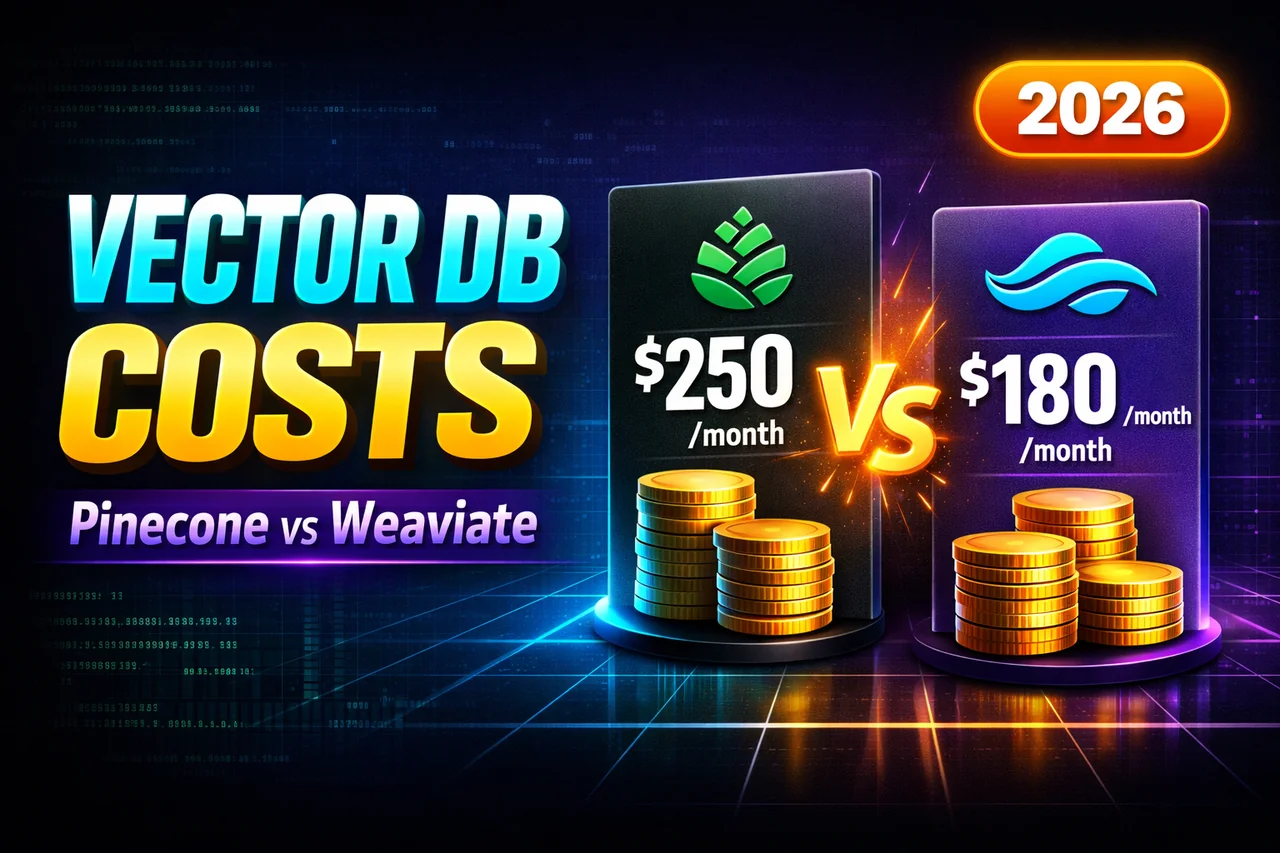
Top 5 Vector Databases for Enterprise RAG: Pinecone vs. Weaviate Cost Comparison (2026)
The “Gold Rush” of Vector Databases has settled. In 2026, the market has consolidated around a few key players. For Enterprise CTOs, the question is no longer “What is a vector DB?” but “How much will it cost to store 100 million embeddings?”
Pricing models have shifted from “Per Pod” to “Serverless Consumption.” This is great for startups but dangerous for enterprises with high query volume. This guide breaks down the TCO (Total Cost of Ownership) for Pinecone, Weaviate, Milvus, and Qdrant.
The 2026 Pricing Models: Read vs. Write vs. Storage
There are three levers that pull money from your wallet:
- Storage: How many GBs your vectors take up (Dimension count matters!).
- Write Units (Ingestion): How much it costs to upload/update data.
- Read Units (Queries): How much it costs to search.
1. Pinecone (Serverless)
Pinecone eliminated “Pod Management” in 2024. Now, you pay for what you use.
- Storage: $0.33/GB/month.
- Reads: $8.25 per 1M Read Units.
- Writes: $2.00 per 1M Write Units.
The Catch: “Namespace Isolation” is free, but if you have high-throughput applications (1000 QPS), the Read Units bill can scale linearly, becoming expensive quickly.
2. Weaviate Cloud (WCD)
Weaviate offers “SLA-based” pricing. You pick a tier (Standard, Enterprise) and pay based on “Vector Dimensions Stored.”
- Pricing: ~$0.095 per 1M vector dimensions.
- Advantage: Predictable. You don’t get punished for query spikes.
- Hybrid Search: Included in the base price (keyword + vector).
3. Milvus (Zilliz Cloud)
Zilliz (managed Milvus) uses “CU” (Compute Units). You rent capacity.
- Pricing: ~$0.15/CU/hour.
- Advantage: DiskANN technology. You can store 10x more vectors on cheap SSD storage rather than expensive RAM, lowering the effective cost per million vectors significantly for massive datasets.
Cost Simulation: The “Knowledge Base” Scenario
Scenario: An enterprise storing 10 Million Vectors (1536 dimensions, OpenAI embeddings) with 50 GB of metadata.
Option A: Pinecone Serverless
- Storage (70GB): $23/month.
- Writes (Initial Load): $20 (One-time).
- Reads (5M queries/month): $41.
- Total Monthly: ~$64.
Option B: Weaviate Cloud
- Dimensions Pricing: ~$85/month.
- Total Monthly: ~$85.
Option C: Self-Hosted Qdrant (on AWS EC2)
- Instance (r6g.xlarge): $150/month.
- EBS Volume: $10/month.
- DevOps Time: $500/month (allocated).
- Total Monthly: ~$660.
Verdict: For datasets under 50M vectors, Managed SaaS (Pinecone/Weaviate) is drastically cheaper than self-hosting due to the hidden cost of DevOps.
The “Hybrid Search” Tax
In 2026, pure vector search is rarely enough. You need Hybrid Search (Vectors + Keywords).
- Pinecone: Supports sparse vectors (SPLADE) but increases storage costs.
- Weaviate: Native BM25 support. No extra storage cost for keyword indices.
- Qdrant: Fast, filterable HNSW. Excellent for complex metadata filtering (e.g., “Find shoes similar to this image BUT only in size 10”).
Migration Costs: Lock-in Risk
Moving 100 Million vectors from Pinecone to Weaviate creates a massive Egress Bill from AWS/GCP.
Strategy: Always store your source-of-truth embeddings in cold storage (S3/GCS/Parquet) before indexing them in the vector DB. This allows you to “re-hydrate” a new database without paying egress fees to the old DB provider.
Conclusion
- Best for Startups: Pinecone Serverless. Zero fixed costs. Scale to zero.
- Best for RAG Agents: Weaviate. Superior hybrid search for fetching accurate context.
- Best for “Big Data” (>1B Vectors): Milvus/Zilliz. The disk-based indexing saves thousands of dollars in RAM.
Sources:
- Official Pricing Calculators: Pinecone, Zilliz, Weaviate (Jan 2026).
- DB-Engines Ranking: Vector DBMS Trends 2026.
- TechCrunch: The Economics of RAG in the Enterprise.
Author update
Pricing changes quickly. I will keep this post updated with new rates and break-even examples. If you want a custom scenario modeled, share your volumes and constraints.