
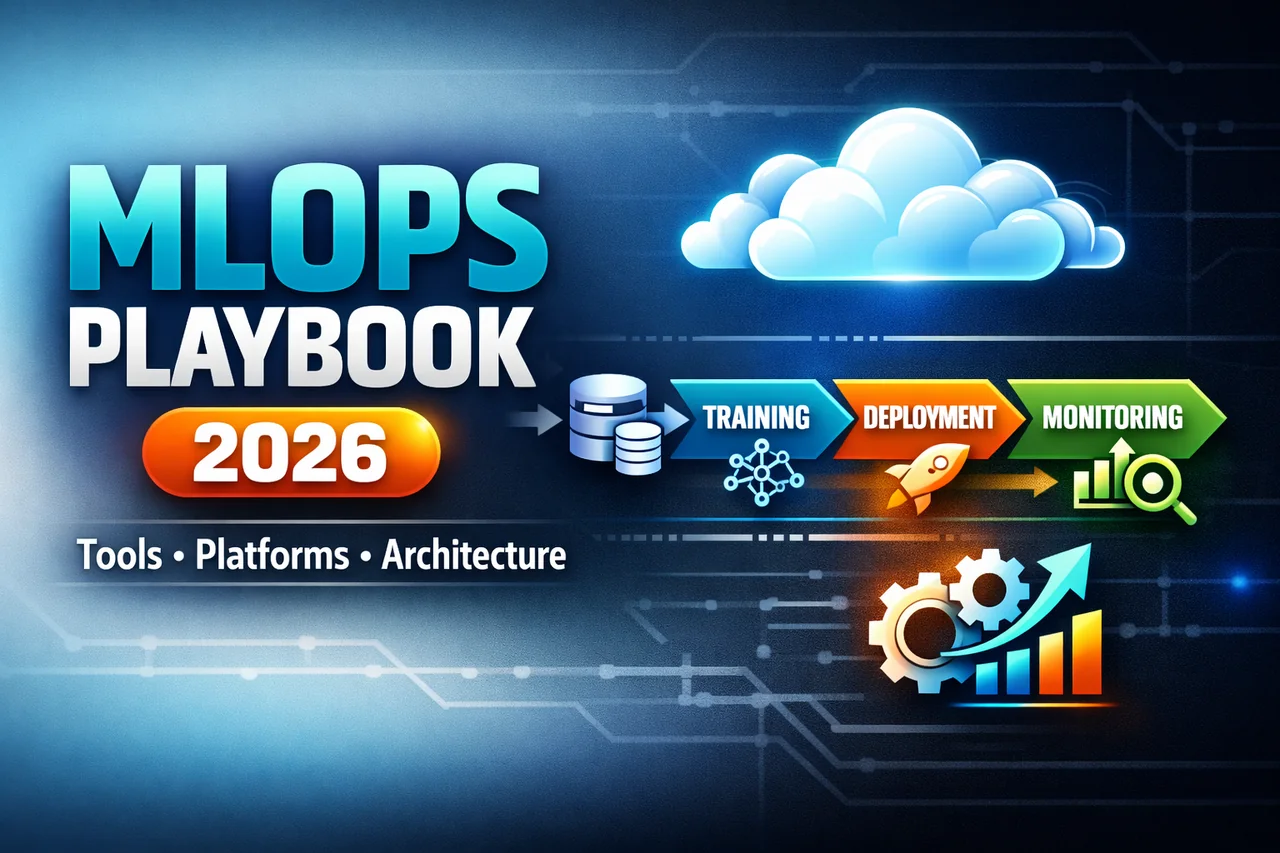
MLOps in 2026 — The Definitive Guide: tools, cloud platforms, architectures, and a practical playbook
MLOps in 2026 — The Definitive Guide: tools, cloud platforms, architectures, and a practical playbook
Executive summary
MLOps — the discipline of operationalizing machine learning — has matured into a core engineering function in 2026.
Over the last two years (2024–2026) the industry shifted from ad-hoc pilot projects to repeatable, auditable, enterprise-grade ML systems.
Tooling matured in three important ways: (1) feature stores and data-lake / lakehouse integrations became standard infrastructure,
(2) experiment & prompt tracking expanded into GenAI observability primitives, and (3) specialized LLM/RAG tooling (vector stores,
prompt/version control, hallucination diagnostics) entered mainstream MLOps stacks. Evidence of this consolidation includes the Tecton →
Databricks integration announced in 2025 and the release of MLflow 3 with GenAI-oriented features in mid-2025.
This guide is a practical, hands-on playbook. It covers the full lifecycle, a comprehensive tools catalogue (feature stores, registries,
orchestration, vector DBs, observability), cloud-provider recommendations (AWS, GCP/Vertex AI, Azure, Databricks), LLMOps specifics,
architecture blueprints, cost and procurement guidance, and a step-by-step 90-day implementation plan your team can execute.
Why MLOps matters in 2026
Several forces made MLOps non-negotiable for modern AI teams:
- Scale & velocity: organizations deploy more and more models; without reproducible pipelines and CI/CD, teams face technical debt and outages.
- Cost & efficiency: cloud compute for training/inference is now a major expense — reproducible experiments and experiment tracking reduce wasted runs.
- Regulation & auditability: regulators and internal risk teams require lineage, model cards, and auditable approval workflows.
- New workload types: LLMs introduced prompt/versioning, embeddings, and RAG, requiring new infra (vector DBs) and observability signals (hallucination metrics, token cost).
Platform vendors and open-source projects reacted: MLflow expanded to explicitly support GenAI workflows (prompts, LLM evaluation), while feature-store projects and vendors integrated real-time serving with lakehouse platforms (e.g., the Tecton integration into Databricks’ Agent Bricks strategy). These are clear signs the industry is standardizing the MLOps stack.
MLOps lifecycle — expanded walkthrough
1. Problem scoping and metric definition
Start with a closed, measurable business objective: the KPI your model must move (e.g., reduce false positives by X%, improve conversion by Y%).
Define data contracts: schema, freshness SLA, owner, and classification (PII, sensitive). Clear contracts reduce breakage and miscommunication later.
2. Data ingestion & validation
Build repeatable ingestion patterns from the source system into a controlled storage (data lake / warehouse). Use schema and distribution assertions
(Great Expectations, whylogs) to fail fast on bad data and to log metadata for lineage. WhyLabs/langkit and similar libraries are now commonly used
to extract LLM-specific text signals.
3. Feature engineering & stores
Key best practice: write features once and serve them everywhere. Feature stores (Feast, Tecton, Databricks Feature Store) provide the plumbing to
compute, materialize, version, and serve features to training and inference consistently. Feast’s roadmap shows active work on vector/search integration,
acknowledging that embeddings are now features too.
4. Experiment tracking, metadata & reproducibility
Track code commit, container environment, dataset version, hyperparameters, random seeds, and experiment outputs. Tools such as MLflow, Weights & Biases,
and Neptune log runs and facilitate reproducibility and collaboration. MLflow 3 (released in 2025) added explicit support for GenAI workflows (prompt
tracing, LLM judges) to make these artifacts first-class in experiment metadata.
5. Model validation & automated gates
Automate validation in CI: unit tests for transformations, holdout evaluation for performance, fairness checks, and LLM-specific tests (factuality,
toxicity heuristics). Implement promotion gates in model registries requiring manual approval for high-risk models.
6. Serving & deployment
Choose a serving strategy suited to your latency and throughput needs: containerized microservices (Kubernetes), managed endpoints (SageMaker, Vertex),
or specialized servers (NVIDIA Triton) for GPU-optimized inference. For LLMs, add caching, batching, and cost-aware routing (small models for simple requests,
large models when necessary).
7. Observability & monitoring
Observability must bridge model signals to business KPIs. Track infra signals (latency, error rates), model signals (confidence, calibration), data
signals (distribution drift), and LLM signals (hallucination/factuality scores, token cost). Vendors such as Arize and WhyLabs expanded LLM-focused
feature sets in 2025 to capture these exact signals.
8. Retraining, rollback & lifecycle ops
Automate retraining triggers based on drift or time-based policies. Implement blue-green or canary promotion strategies with automated rollback rules tied
to monitored business KPIs. Document artifact retention and the process for forensic analysis.
9. Governance, audit & explainability
Maintain model cards, lineage metadata, approval logs, and reproducible run artifacts. Use explainability tools for regulated models and capture human-review
actions as part of the run metadata.
Core components & capabilities (what you need)
A modern MLOps stack maps to concrete capabilities. Successful teams prioritize the following building blocks and select tools that match their scale, compliance needs, and engineering maturity.
Data & ingestion
- Event bus & streaming: Kafka, Kinesis, Pub/Sub (for real-time features).
- Batch ingestion: scheduled ETL into cloud object storage (S3/GCS) or warehouses (BigQuery, Snowflake).
- Data validation: Great Expectations, whylogs/WhyLabs for automated assertions and observability.
Feature management
- Feature stores: Feast (open-source), Tecton (enterprise), Databricks Feature Store (lakehouse-integrated). Many stores now add vector/embedding support to treat embeddings as first-class features.
Experiment tracking & model registry
- Tracking & registry: MLflow (with GenAI features), Weights & Biases, Neptune. Register models, attach metrics, and maintain promotion workflows.
Orchestration & CI/CD
- Orchestration: Airflow for batch pipelines, Argo Workflows / Kubeflow for Kubernetes-native ML pipelines.
- CI/CD: GitHub Actions, GitLab CI, and vendor pipeline services (SageMaker Pipelines, Vertex Pipelines) to automate training & deployments.
Serving & inference
- Managed endpoints: SageMaker Endpoints, Vertex AI Endpoints — both provide autoscaling and model version management.
- Self-hosted serving: KServe, Seldon Core, BentoML for flexibility; Triton for GPU efficiency.
Observability & monitoring
- Vendors & OSS: Arize, WhyLabs (LangKit + whylogs), Fiddler, Datadog AI Observability — each offers drift detection, root-cause analysis, and LLM-specific signals.
Vector stores & retrieval
- Vectors/embeddings: Pinecone (managed), Milvus (open-source), Weaviate, Chroma. Consider index type (IVF/HNSW/OPQ), recall/latency tradeoffs, and persistence strategies.
Security, governance & infra
- IAM, VPCs, KMS, audit logs, model cards, explainers (Alibi, Fiddler), and secure data handling policies for PII.
- Infra-as-code (Terraform), GitOps, and secrets management (HashiCorp Vault) for reproducible infra.
Comprehensive tools catalogue — by capability
Below is a pragmatic catalogue of tools you should evaluate. I grouped them by capability and included short notes on strengths and typical use-cases.
Feature stores
- Feast (open-source) — Portable, widely-adopted feature store for consistent serving during training & inference. Feast’s roadmap includes vector-search additions recognizing embeddings as features. Good for hybrid/multi-cloud environments and teams wanting portability.
- Tecton — Enterprise-grade real-time feature store focused on low-latency serving. Strategic platform integrations (e.g., Databricks acquiring Tecton for agent workflows) indicate its real-time capabilities are commercially valued.
- Databricks Feature Store — Useful for teams that run lakehouse-oriented pipelines and want tight integration between storage, compute, and feature serving.
Experiment tracking & model registry
- MLflow — Popular open-source tracking and registry. MLflow 3 improved GenAI support (prompt tracing, LLM judges, unified experimentation), making it a central option for mixed predictive + generative workloads.
- Weights & Biases (W&B) — Rich visualization & collaboration features; excels where rapid iteration and experiment comparison are required.
- Neptune.ai — Lightweight and developer-friendly experiment logging plus dashboards for teams that want minimal overhead.
Orchestration & workflow engines
- Apache Airflow — Great for batch ETL & daily retraining workflows; mature ecosystem.
- Argo Workflows — Kubernetes-native orchestration for containerized ML pipelines; integrates well with GitOps practices.
- Kubeflow Pipelines — ML-first pipelines on Kubernetes with strong integration to TF/PyTorch tooling.
- Managed pipeline services — SageMaker Pipelines, Vertex Pipelines for organizations seeking vendor-managed CI/CD for ML.
Serving & inference
- SageMaker Endpoints / Serverless Inference — Managed, autoscaling endpoints; integrates with SageMaker model registry and pipelines.
- Vertex AI Endpoints — GCP-managed model deployment with autoscaling and integrated monitoring; strong when BigQuery/Vertex ecosystem is core.
- KServe / Seldon Core — Kubernetes-native model serving frameworks that support canary, A/B testing, and extensibility.
- NVIDIA Triton — High-performance GPU inference server for throughput-sensitive workloads.
- BentoML — Developer-friendly packaging and serving with multi-backend support.
Observability & monitoring
ML observability is now a multi-dimensional problem; vendors added LLM-specific capabilities in 2024–2025.
- Arize AI — Focused on model performance, root-cause analysis, and LLM evaluation; Observe 2025 showcased agent/LLM evaluation tooling.
- WhyLabs (whylogs / LangKit) — Data & LLM observability (LangKit for text metrics) and an open approach to metric extraction.
- Fiddler AI — Enterprise-grade explainability and compliance with LLM-monitoring features. (Fiddler expanded LLM monitoring in 2025.)
- Datadog — Infrastructure + application + LLM signals in one place; useful for teams that prefer a single vendor for observability.
Vector / embedding stores
Vector DBs power retrieval-augmented generation. Evaluate index types, persistence, multi-tenancy, and SDK ergonomics when choosing a vector store.
- Pinecone — Managed, serverless vector DB optimized for scale and developer productivity. Pinecone’s 2025 release notes focused on large-scale testing and performance engineering.
- Milvus — OSS vector DB with active roadmap for performance and storage features; available managed via third parties.
- Weaviate — Open-source with built-in ML features and a semantic search focus.
- Chroma — Lightweight, popular in prototypes and small to medium RAG deployments; available in cloud-hosted forms.
Data processing & storage
- Lakehouse / data warehouse: Databricks (Delta Lake), Snowflake, BigQuery.
- Stream processing: Kafka, Flink, Spark Structured Streaming for real-time feature computation.
Security & governance
- IAM, VPCs, KMS, audit logs, and model-risk frameworks. Use model cards, access controls, and explainability to satisfy regulators and audit teams.
Cloud provider overview & recommended tradeoffs
The major cloud providers and managed platforms offer comprehensive MLOps toolchains. Choose based on your current cloud footprint, integration needs,
compliance demands, and tolerance for vendor lock-in.
AWS — SageMaker & the AWS MLOps ecosystem
AWS offers an end-to-end stack: SageMaker Pipelines for CI/CD, SageMaker Model Registry, hosted endpoints (including serverless options), integrated
monitoring, and security integrations with IAM/CloudTrail. SageMaker’s MLOps documentation and templates are useful for teams wanting a managed path
with strong governance features. AWS continues to expand MLOps templates and capabilities across 2024–2025.
GCP — Vertex AI & Agent Builder
Vertex AI bundles training, pipelines, endpoints, and agent/GenAI tooling (Agent Builder) into a unified service. Vertex is particularly compelling for teams
using BigQuery or wanting tight integration with Google’s model ecosystem. Vertex’s release notes through late 2025 show continued investment in agent tooling
and pipeline automation features.
Azure — Azure Machine Learning
Azure ML emphasizes enterprise governance, hybrid-cloud scenarios, and integration with Microsoft stacks. It provides model registries, pipelines, and a familiar
governance model for enterprises already embedded in the Microsoft ecosystem.
Databricks & Lakehouse
Databricks positions the lakehouse as the unified data + AI platform. The strategic integration with Tecton (announced in 2025) is an example of vendors trying to
reduce wiring effort by owning feature serving and agent integrations. If your org’s workloads are feature-heavy and data-engineering-centric, a Databricks-first
approach significantly reduces integration work.
Managed vs self-managed tradeoffs
- Managed (fast time-to-value): SageMaker, Vertex, Databricks — less ops overhead but more lock-in risk.
- Self-managed (control & portability): OSS stack on Kubernetes — more operational effort but greater flexibility (Feast, MLflow, Airflow, Milvus).
- Hybrid: Common pattern — managed warehouse/lakehouse + self-hosted model serving, or managed vector DB + self-hosted feature store.
LLMOps — special considerations for generative AI
LLMs added new operational primitives: prompt/versioning, embedding freshness, retrieval engineering (RAG), hallucination/factuality monitoring,
token-cost management, and human-in-the-loop flows for safety-critical tasks.
Prompt & prompt-evaluation tracking
Track prompts, system messages, temperature, and post-processing steps alongside outputs and evaluations. Treat prompts as code/artifacts with versions
and tests; MLflow 3 introduced GenAI primitives to help teams track these artifacts within the experiment lifecycle.
Embeddings & vector management
Embeddings are features: you must version embedding models, control re-embedding schedules, and monitor vector DB recall & latency. Pinecone and Milvus
both published 2025 updates and roadmaps emphasizing scale and index testing to support production RAG workflows.
LLM observability & hallucination detection
LLMs require metrics beyond accuracy: hallucination/factuality heuristics, chain-of-thought traceability, and token usage. Observability vendors added
specialized tools in 2025 (Arize’s Observe events, WhyLabs’ LangKit) to extract text-level metrics and provide dashboards.
Cost-aware routing & caching
Route low-complexity queries to smaller, cheaper models and cache responses for repeated queries. Batching and chaining inference requests lowers token spend.
Human oversight
For high-risk outputs (legal/medical/finance) always include human-in-the-loop review and escalation workflows. Record human decisions in the run metadata for audits.
Architecture patterns & blueprints
Pattern A — Lightweight cloud-native (startups)
- Storage: S3/GCS + a simple table snapshot for training.
- Experiment tracking: MLflow or W&B for reproducibility.
- Pipelines: GitHub Actions + Airflow or managed pipelines for reproducible runs.
- Serving: Serverless endpoints (SageMaker Serverless / Cloud Run) or small K8s cluster.
- Monitoring: basic infra + WhyLabs/Arize for drift checks when you cross a threshold of production model usage.
Pattern B — Real-time, low-latency (finance/adtech)
- Event ingestion via Kafka / Kinesis → stream transform (Flink / Spark Structured Streaming).
- Feature store: Tecton / Feast for sub-second retrieval; materialize features to a low-latency store for serving.
- Training: distributed training clusters; Kubeflow/Argo Pipelines for reproducible training & deployment.
- Serving: KServe / Seldon + autoscaling & canary rollouts; integrate with automated rollback policies tied to business metrics.
Pattern C — LLM + RAG + Agent
- Knowledge ingestion → document processing → embeddings → vector DB (Pinecone / Milvus) with metadata and TTL for freshness.
- Retrieval layer returns candidates → LLM composes responses; prompt/chain orchestration ensures safe function calls and auditing.
- Observability tuned to hallucination metrics, token costs, and RAG retrieval recall/precision.
Observability, monitoring & governance — how to instrument properly
Essential signals to collect
- Infra: latency (p50/p90/p99), error rates, GPU/CPU utilization, queue depths.
- Model: prediction distributions, confidence, calibration, per-slice performance (by region, customer, segment).
- Data: schema changes, missing fields, distribution drift (statistical divergence tests).
- Business: downstream KPIs tied to model versions (conversion, churn, fraud) — critical to detect silent failures.
- LLM-specific: hallucination/factuality scores, token usage & cost, prompt performance, function-call frequency.
Instrumentation patterns
- Log raw inputs & outputs (sanitize PII) for every inference to allow replay and debugging.
- Export features used in inference to observability platform or store, to compare training vs serving distributions.
- Use an ML observability platform (Arize, WhyLabs, Fiddler) to centralize alerts and automate root-cause analysis.
- Define thresholds and runbooks for alerts (for example: if conversion drops by >5% in 24 hours for a high-value cohort, trigger incident response).
Governance & audit readiness
For regulated use-cases, maintain model cards, lineage metadata, and access logs. Automate the collection of proof artifacts for audits: model training datasets,
validation results, approvals, and deployment timestamps.
Cost, vendor consolidation & procurement guidance
The MLOps market saw consolidation in 2024–2025 as vendors added integrated features and acquired complementary technology (e.g., Databricks’ acquisition/integration of Tecton).
Consolidation improves time-to-value but can increase lock-in. Use the following procurement lens:
- Prioritize integration vs portability: Managed platforms (SageMaker, Vertex, Databricks) accelerate delivery; OSS stacks offer portability and control.
- Export capability: Prefer tools that let you export models, metadata, and features in neutral formats (MLflow artifacts, ONNX, Parquet snapshots) to avoid being trapped.
- Start small: Adopt experiment tracking + pipeline automation + basic monitoring first; expand to feature stores and enterprise observability as the model count and traffic grows.
- Negotiate TCO & support: For large-scale deployments, ensure SLAs for managed services and verify support for data residency and compliance requirements.
Practical 90-day roadmap (Day 0 → Day 90)
Phase 0 — Days 0–7: Quick wins
- Select one high-impact use case and define a measurable success metric.
- Install experiment tracking (MLflow or W&B) and require commit IDs and dataset versions for all runs. MLflow 3.x helps with GenAI artifacts if you run LLM experiments.
- Start capturing inference logs (inputs/outputs) to an immutable store for auditing and debugging.
Phase 1 — Days 7–30: Standardize & automate
- Automate training pipelines (Airflow / Argo / managed pipelines). Use CI to run unit tests for data transforms and model evaluation steps.
- Introduce model registry and promotion workflow (dev → staging → production). Automate approvals for low-risk models; require manual approval for high-risk ones.
- Implement basic monitoring: latency, errors, and a simple drift test (WhyLabs / Arize).
Phase 2 — Days 30–90: Harden & govern
- Introduce a feature library or feature store (Feast recommended for OSS; consider Tecton or Databricks if real-time low-latency serving is required).
- Implement canary/blue-green deployments with automated rollback triggered by business-metric degradation.
- Define access controls, artifact retention policies, and produce model cards for production models.
- Run a cost analysis and set alerts for runaway training/serving bills; implement autoscaling and batching for inference cost reduction.
Checklist, glossary & recommended reading
Pre-production checklist
- Experiment tracking fully enabled across teams.
- Immutable snapshots of training data and a documented data contract.
- Automated tests for transforms and data schema (Great Expectations).
- Model registry and documented promotion workflow with approval gates.
- Monitoring: infra, model, data drift, and LLM-specific signals (if applicable).
- Feature store or shared feature library for training/serving parity.
- Model cards and retained audit logs for compliance.
Short glossary
- Feature store
- System that stores, versions, and serves features for both training and inference (e.g., Feast, Tecton). Feast roadmap includes vector-search integration.
- Model registry
- Repository for model artifacts and metadata with lifecycle states. MLflow is a common choice and added GenAI features in 2025.
- Vector DB
- A specialized database for storing and querying embeddings used in RAG (Pinecone, Milvus, Weaviate). Pinecone and Milvus published 2025 updates focused on scale and performance.
- LLMOps
- Operational practices for LLMs, including prompt/versioning, embedding management, hallucination detection, and token-costing. Observability vendors added LLM tooling in 2025.
Selected recommended reading & source highlights
- Databricks blog on Tecton joining Databricks — real-time feature serving & agent integration.
- MLflow 3 release notes — GenAI & prompt/LLM support (June 2025).
- Feast roadmap & project pages — open-source feature store developments (Dec 2025 roadmap).
- Arize’s Observe 2025 material — LLM evaluation and agent reliability features.
- WhyLabs LangKit & LLM monitoring docs — open-source LLM signal extraction.
- Pinecone & Milvus release notes/roadmaps — vector DB scale & performance updates in 2025.
- AWS SageMaker MLOps docs — pipeline, registry, and managed endpoint documentation.
- Vertex AI MLOps & Agent Builder docs — GCP-managed pipelines and agent tooling (2024–2025 updates).
Final thoughts & next steps
MLOps in 2026 is practical engineering: version everything (code, data, features, models), automate tests & promotion gates, and instrument observability
that maps model-level signals to real business outcomes. The ecosystem matured quickly in 2024–2025 — expect continued integration between feature stores,
model registries, vector DBs, and observability platforms in 2026 and beyond.
If you’d like, I can:
- Produce a WordPress-ready version with Yoast SEO meta tags, an excerpt, and OG image suggestions.
- Generate a printable 1-page MLOps checklist PDF or an SVG architecture diagram (startup / enterprise / LLM patterns).
- Tailor the 90-day roadmap to your stack — tell me your cloud (AWS / GCP / Azure / hybrid), expected traffic/training scale (small / medium / high),
and whether you run LLM workloads and I’ll return a 1-page prioritized plan.
Research & sources checked while preparing this guide (selected): Databricks blog on Tecton integration, MLflow 3 release notes, Feast roadmap, Arize Observe 2025,
WhyLabs LangKit docs, Pinecone & Milvus release notes, AWS SageMaker MLOps docs, Vertex AI MLOps docs. Inline citations in the article link to these pages.
Author update
I will keep this guide updated with platform changes and tooling shifts. If you want a follow-up on CI/CD or monitoring, tell me your stack.