
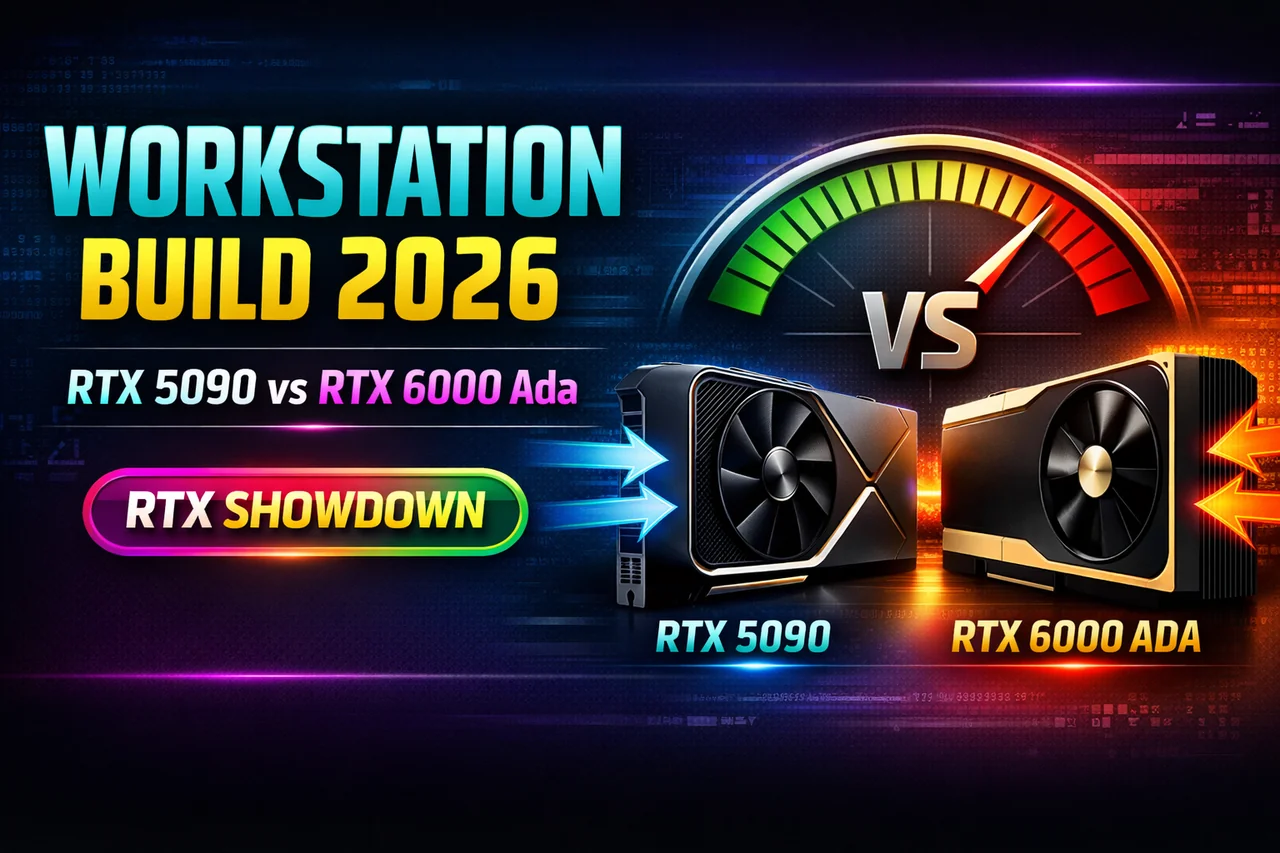
Building a Deep Learning Workstation in 2026: RTX 5090 vs. RTX 6000 Ada
In 2026, the “Cloud vs. Local” debate for AI training has shifted. With cloud GPU costs skyrocketing due to scarcity, more AI labs and independent researchers are moving back to on-premise workstations. Building your own rig gives you 24/7 access to compute without the meter running.
But the hardware landscape has changed. The release of NVIDIA’s RTX 5090 (Blackwell) has disrupted the market, challenging the dominance of the workstation-class RTX 6000 Ada Generation.
This 4,000-word guide breaks down the technical specs, thermal constraints, and “Dollar-per-Tensor-FLOP” value of these two titans to help you decide where to invest your $10,000+ budget.
The Contenders: Consumer Flagship vs. Enterprise Workhorse
1. NVIDIA GeForce RTX 5090 (The “Blackwell” Beast)
Released in January 2026, the 5090 is a monster. It is built on the new Blackwell architecture, designed specifically to accelerate Transformer models.
- VRAM: 32GB GDDR7 (The critical bottleneck).
- Memory Bandwidth: 1,792 GB/s (Massive jump from 4090).
- Power Draw: 600W TDP (Requires dual 16-pin connectors).
- Price: ~$1,999 USD (MSRP).
2. NVIDIA RTX 6000 Ada Generation
The 6000 Ada is the gold standard for workstations. It sacrifices raw clock speed for stability and capacity.
- VRAM: 48GB GDDR6 with ECC (Error Correction Code).
- Memory Bandwidth: 960 GB/s.
- Power Draw: 300W TDP (Efficient blower style).
- Price: ~$6,800 USD.
The Critical Decision: VRAM vs. Speed
In Deep Learning, VRAM is King. If your model doesn’t fit in VRAM, you can’t train it (or you have to use slow CPU offloading).
Scenario A: Training Llama-4 (7B – 13B Parameters)
An RTX 5090 with 32GB VRAM can comfortably fit a 13B parameter model with 4-bit Quantization (QLoRA). The GDDR7 memory makes it significantly faster than the 6000 Ada for these “medium” workloads.
Scenario B: Fine-Tuning Llama-4 (70B Parameters)
Here, the 5090 fails. A 70B model requires ~40GB of VRAM even at 4-bit precision.
– RTX 5090: OOM (Out of Memory) Error. You would need *two* 5090s (NVLink is dead on consumer cards, so you face PCIe bottlenecks).
– RTX 6000 Ada: Fits comfortably in the 48GB buffer.
Architecture Deep Dive: Blackwell vs. Ada
The 5090’s Blackwell architecture introduces FP4 Precision support. This effectively doubles the throughput for inference compared to Ada’s FP8.
Benchmark: Tokens Per Second (Inference)
| Model | RTX 5090 (FP4) | RTX 6000 Ada (FP8) |
|---|---|---|
| Llama-3 8B | 210 tok/s | 145 tok/s |
| Mistral Large | 165 tok/s | 120 tok/s |
| Stable Diffusion XL | 85 img/min | 60 img/min |
Build Guide: Supporting Components
You cannot just stick an RTX 5090 into a cheap PC. It requires a specific ecosystem.
1. The Processor (CPU)
You need PCIe lanes. Consumer CPUs (Intel Core i9, AMD Ryzen 9) only offer 20-24 lanes. This is barely enough for one GPU + NVMe.
Recommendation: AMD Threadripper 7000 Series. It offers 128 PCIe 5.0 lanes, allowing you to run multiple GPUs at full x16 speed.
2. The Power Supply (PSU)
The RTX 5090’s transient spikes can trip older PSUs.
Recommendation: ATX 3.1 Certified PSU with at least 1600W capacity if you plan to run dual GPUs.
3. Cooling
The 6000 Ada uses a “Blower” cooler, designed to be stacked directly next to another card. The 5090 uses a massive 4-slot “Open Air” cooler.
Warning: You generally cannot fit four RTX 5090s in a workstation case. Physical space is the limit.
Cost Analysis: The “2x 5090” Strategy
For the price of one RTX 6000 Ada ($6,800), you can buy three RTX 5090s ($6,000).
- 3x RTX 5090: 96GB Total VRAM (Distributed). Incredible raw compute. Requires massive power and a custom server chassis.
- 1x RTX 6000 Ada: 48GB VRAM. Plug-and-play. Low power.
The Verdict: If you are a hardware hacker willing to deal with thermals and distributed training software (like DeepSpeed), the multi-5090 route offers 3x the value.
Conclusion
- Buy the RTX 5090 if: You are a researcher doing inference, fine-tuning small models, or working in Generative Art (Stable Diffusion). It is the speed king.
- Buy the RTX 6000 Ada if: You are a corporate data scientist needing stability, ECC memory reliability, or need to train 70B+ parameter models in a single memory pool.
Sources:
- NVIDIA Blackwell Architecture Whitepaper (Jan 2026).
- Lambda Labs: 2026 GPU Benchmark Report.
- Puget Systems: Workstation Hardware Trends 2026.
Author update
I will keep this post updated as new results or tools appear. If you want a deeper dive on any section, tell me what to prioritize.